

Brushing and Flossing – Two Key Elements to Avoiding Dental Disease
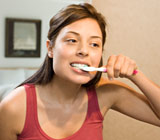 We humans have been cleaning our teeth for millennia. While the tools and substances have changed (we don’t use twigs or pumice anymore), the reasons haven’t: we want a nice, fresh smile and a clean-feeling mouth.
Objectively, though, oral hygiene has one primary purpose — to remove dental plaque, the whitish film of bacteria that grows on unclean tooth surfaces and at the gum line. Removing this decay-causing film can drastically reduce your risk of dental disease.
Effective oral hygiene depends on two primary tasks: brushing and flossing. You should perform these tasks at least once (flossing) or twice (brushing) in a 24-hour period. Brushing involves a simple technique. You hold your toothbrush (a well-designed, multi-tufted brush) in your fingertips with the same pressure as you would a pen or pencil. You then gently scrub all of the tooth surfaces starting at the gum line, holding the brush at a 45-degree. “Gently” is the key word here: it’s possible to damage your tooth and gum surfaces by brushing too vigorously.
While brushing seems easier for people to fit into their daily routine, flossing seems to be harder. It’s just as important, though, because over half of plaque accumulation occurs between teeth, in areas where brushing can miss. Like brushing, flossing isn’t difficult to do. Holding a strip of floss taut by your fingers between both hands, and gently slipping the floss between your teeth you form a “C” shape around each tooth surface as you apply pressure onto the one surface you are cleaning. Gently move the floss up and down for three or four strokes or until you hear a squeaky clean sound (that’s when you know the surface is clean). Then you go to the other tooth surface by lifting the floss above the gum line so that you don’t damage the gum tissue in between the teeth.
You should also schedule regular checkups and cleanings with our office to supplement your daily routine. Professional cleanings remove any hidden plaque that brushing and flossing may have missed. A checkup also gives us a chance to evaluate how well your hygiene program is progressing. Our partnership in proper oral hygiene can make all the difference in you avoiding tooth decay and other dental diseases.
If you would like more information on proper oral hygiene, please contact us for a consultation.
Matthew Lewis’s Metamorphosis
 Remember Matthew Lewis? You’ve seen him in all of the Harry Potter movies, where he played the bumbling Neville Longbottom: a pudgy, teenage wizard-in-training whose teeth could best be described as… dodgy. We won’t spoil the movie by telling you what happens to him in the end — but in real life, let’s just say his awkward phase is over. Today, he looks more like a young Ryan Gosling. How did this transformation happen?
Well, in part it was some “Hollywood magic” that made his teeth look worse in the films than they really were. But Lewis acknowledges that he also had cosmetic dental work performed. If you’ve ever considered getting a smile makeover yourself, you may wonder: What kinds of “dental magic” might it take to change an awkward grin into a red-carpet smile? Here are a few of the treatments we might utilize.
Orthodontics
It’s possible to correct tooth crowding, protrusion, gaps between teeth, and many other bite problems with orthodontic appliances like braces or clear aligners. While some may think orthodontics is just for teens, that isn’t so — you’re never too old to get the smile you’ve always wanted! In fact, right now about one in five orthodontic patients is an adult.
Teeth Whitening
This is a popular (and surprisingly affordable) option that can effectively lighten your teeth by six shades or more. We can do in-office whitening for the fastest results, or prepare a take-home whitening kit with a custom-made tray to fit your teeth perfectly and a supply of the proper bleaching solution. How well it will work for you (and how long it will last) depends on various factors, including the original cause of the discoloration, and your preferences for foods and beverages (such as coffee or red wine) that may cause stains.
Porcelain Veneers
Sometimes, even professional bleaching isn’t enough to get the kind of permanent, “Hollywood white” smile you’d like; that’s where porcelain veneers come in. By placing a fingernail-thin layer of ceramic over the tooth’s enamel, veneers offer a permanent, pearly white finish that looks just like your natural teeth — only more dazzling! Veneers, long the first choice of celebrities, are gaining popularity with plenty of “regular” folks.
Tooth Restorations
This category covers a wide variety of different methods and materials — like cosmetic bonding, crowns, bridges, and dental implants — which we use to repair or replace teeth that are damaged or missing. Beginning with the simple repair of small chips or cracks with tooth-colored resins, we can progress to more permanent crown restorations when more of the tooth structure needs replacement. To restore missing teeth, we have the option of using the tried-and-true bridge — or, the current gold standard in tooth replacement: the lifelike, permanent dental implant.
Of course, this is just a bare outline of the many tools and techniques cosmetic dentistry offers. We would be happy to talk with you about which ones are right in your individual situation. Will a smile makeover land you a red-carpet role? Maybe… but one thing is for sure: It will help you get the smile youâ??ve always wanted.
If you would like more information on how we can address your problems with sleep apnea, please contact us for a consultation.
Achieving a Transformed Smile With Porcelain Veneers or Crowns
 Today’s cosmetic dentist can bring amazing transformations to their patient’s smiles. That’s because we now have a versatile array of materials and processes that precisely replicate the appearance of natural teeth.
Two of the most useful are porcelain veneers and crowns. Although different in structure and function, veneers and crowns both utilize a material known as dental porcelain, a ceramic material that can be shaped to resemble an individual patient’s natural tooth shape, with the same color, hue saturation and translucence as the original or surrounding teeth.
As the name implies, veneers are a thin layer of dental porcelain that adheres to the outer surface of a tooth, essentially as a replacement for enamel. They solve a number of esthetic issues patients have with their teeth, especially those in front: poor color, shape and contours; broken teeth; poor tooth position; and staining that can’t be removed with conventional bleaching. They most often require minimal tooth preparation, as only 1 mm or less of tooth enamel needs to be removed. Occasionally, no tooth reduction is required.
However, they are not a good solution where there is not an adequate amount of tooth structure to work with. In this case, a crown may be the best choice. A crown (or cap) covers the remaining tooth structure completely, reinforcing the remaining tooth structure 360°. This is an excellent choice for patients who have lost a large amount of tooth structure due to decay, trauma or grinding habits that have eroded the enamel.
To determine if you are a true candidate for either of these applications you should undergo a smile analysis in our office. During this process it’s even possible to create a diagnostic mock-up — a “trial smile,” if you will — with temporary tooth-colored materials applied to your teeth and then photographed for your review.
The smile analysis helps us recommend the best solution for you and in turn will help you make an informed choice on the right application for you. Although either option may not be feasible in all situations, they may just be the right choice to change your smile for the better.
If you would like more information on how we can address your problems with sleep apnea, please contact us for a consultation.
 Dr. Nawar Sileewa D.D.S (The Tooth Booth) 32560 Utica Road Fraser , MI 48026
 (586) 293-8530





