

Christie Brinkley’s Tips on Tooth Whitening
 Christie Brinkley’s world-famous smile has graced the covers of countless magazines for over 30 years. In fact, in her own words from an interview with Dear Doctor magazine, the supermodel said, “I think my smile was really my passport to success in the modeling industry.” And while most of her smile’s appeal comes naturally, Christie does give it a boost with good oral hygiene, regular dental checkups and tooth whitening. As Christie says, “When it comes to teeth, keep it as natural as possible. Do not go overboard on whitening. You want your teeth to compliment your faceâ¦your friends should not be required to wear sunglasses when you smile!”
Aside from some potential minor side effects such as tooth sensitivity, whitening teeth through bleaching is a relatively inexpensive way to brighten your smile conservatively and successfully. There are three common methods, as described below:
- An external or vital approach where “vital” (living) teeth are bleached through direct contact to the tooth’s surface.
- An internal or non-vital approach where the tooth is whitened from the inside during a root canal treatment.
- A combination approach in which both internal and external bleaching techniques are used.
But what causes teeth to become discolored?
Tooth discoloration can be caused by a traumatic blow to your teeth resulting in nerve tissue (pulp) death. However, there can be many other causes: consuming or using products that stain the teeth such as coffee, tea, cola, tobacco products and red wine, to name just a few. Aging is another factor, as it results in changes in the mineral structure of the tooth as the enamel, the outermost layer, loses its beautiful and youthful translucency. Other causes include exposure to high levels of fluoride; tetracycline, an antibiotic, administered during childhood; inherited developmental disorders and jaundice in childhood; and tooth decay.
The good news is that we routinely brighten smiles through tooth whitening. if you are ready to have your teeth professionally whitened, contact us today so that we can conduct a thorough examination and discuss your whitening treatment options.
Advanced Periodontal Disease Requires an Aggressive Treatment Strategy
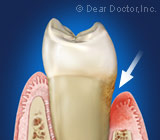 Periodontics is a branch of dentistry that specializes in the supporting structures around the teeth, including the gums and bone, as well as the ligaments that join these structures to the tooth roots. From the Latin peri (“around”) and the Greek odont (“tooth”), periodontics serves one purpose: to keep these supporting structures healthy.
This specialty is critical when it comes to periodontal disease. The term actually refers to a category of inflammatory diseases that affect the periodontal tissues. The inflammation arises from the body’s response to bacterial plaque that has collected at the gum line because of poor oral hygiene. It begins as gingivitis (inflammation of the gums), but if left untreated can develop into periodontitis, which results in bone loss. If left to continue, eventual tooth loss occurs.
Proper oral hygiene and regular cleanings are your best defense against developing periodontal disease in the first place. Once the disease gains a foothold in the area below the gum line, routine brushing and flossing will not be enough. To defeat the disease will require more aggressive treatment.
This usually begins in our office with oral hygiene instruction, scaling and root planing or debridement to rid the root surfaces of plaque and calcified deposits, also referred to as tartar or calculus. This may be followed up with a surgical procedure to remove any remaining pockets that were too deep to resolve with conservative treatment.
Another option we may add to your oral hygiene routine is the use of an anti-microbial mouthrinse, usually containing a 0.12% solution of chlorhexidine. We may also prescribe the use of a topically-applied antibiotic such as tetracycline to stop the infection and promote tissue healing.
Once the disease is arrested, it’s important that you continue good oral hygiene practices. Vigilance and prevention are critical to keeping these all important structures around your teeth healthy and functioning.
If you would like more information on the diagnosis and treatment of periodontal disease, please contact us for a consultation.
Did You Know? Minor Tooth Contouring and Reshaping Can Enhance Your Smile!
 Some dental procedures that can beautify a smile — orthodontics or implants, for example — take months. Others take only minutes! Tooth contouring and reshaping is one of them. So just what is this remedy, and why would you need it?
Tooth contouring involves removing a tiny amount of enamel (the tooth’s outer covering) with a dental drill to sculpt a more pleasing shape and make the tooth fit in better with its neighbors. It is most often used on highly visible teeth that have minor yet noticeable cosmetic flaws.
For example, you may have a tiny chip in a front tooth, a slight size discrepancy among adjacent teeth, or extra-pointy canines. None of these issues are as serious as, say, a misaligned bite or a tooth that’s missing altogether — but they can be annoying nonetheless. If you find yourself staring in the mirror at any of these subtle yet distracting imperfections in your own smile, you may want to consider having us reshape a specific tooth or teeth.
Contouring can correct small chips, uneven tooth length, slight overlaps, and tooth edges that are too flat or pointy. We can also give teeth a more “feminine” or “masculine” appearance, simply by rounding or squaring the edges. Contouring also has a non-cosmetic use: It can be employed to adjust the bite so that the teeth come together more evenly. For example, if one tooth is just a little higher than the others, it might be subjected to more than its share of stress during chewing. This brings up another important point: We would not recommend tooth contouring if any bite imbalances could result from the procedure. And if we do determine that tooth contouring would not be the best way to go in your particular case, don’t worry — we can come up with a solution for any cosmetic issues that are of concern to you.
If you have any questions about tooth contouring and reshaping — or any other cosmetic dentistry procedures — please contact us for a consultation.
 Dr. Nawar Sileewa D.D.S (The Tooth Booth) 32560 Utica Road Fraser , MI 48026
 (586) 293-8530





